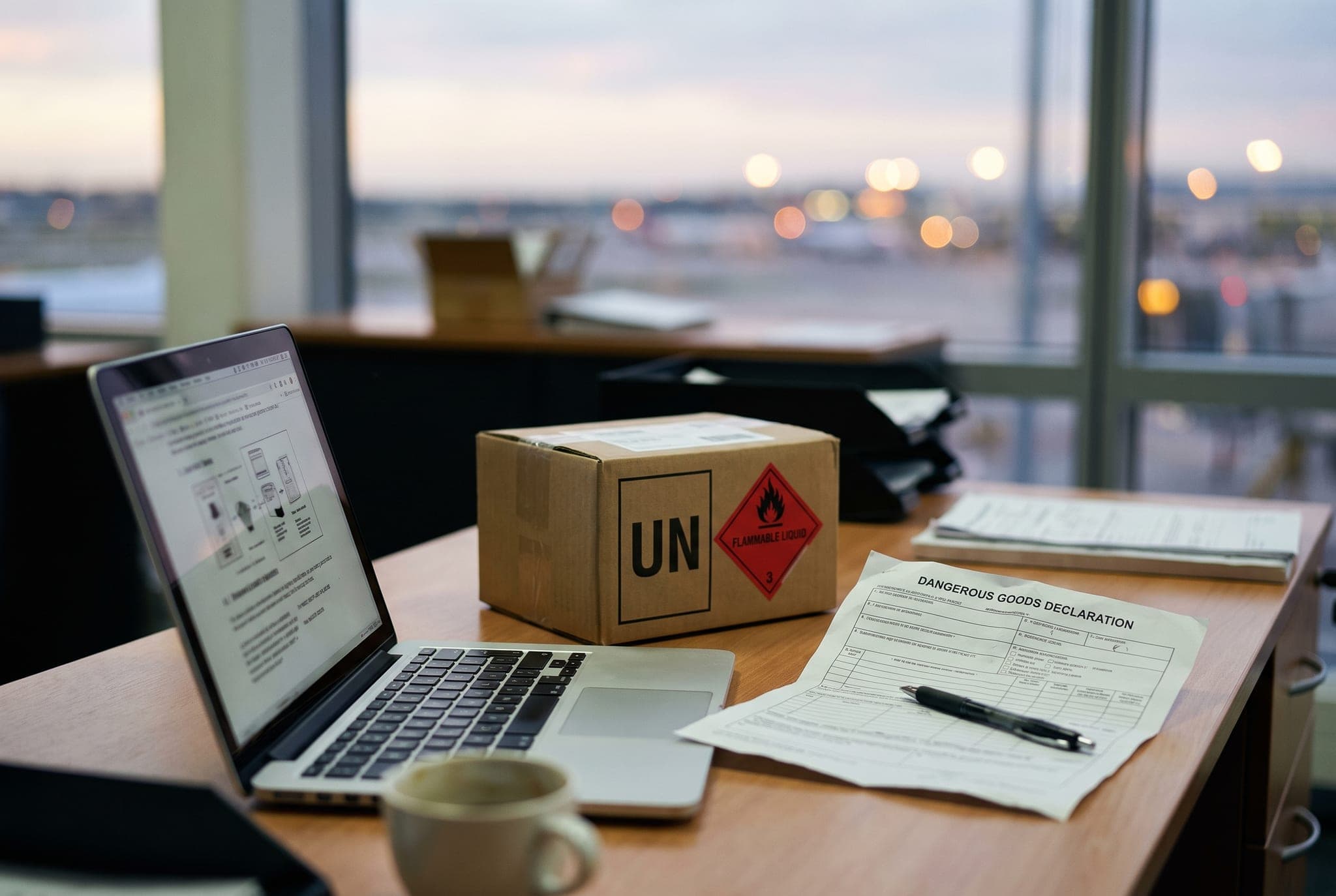
The 9 Classes of Dangerous Goods, Explained
Updated 2026-09-23 · DGM One
Nine classes cover the whole of dangerous goods, from Class 1 explosives to Class 9, the miscellaneous catch all for everything else regulated. The UN Recommendations on the Transport of Dangerous Goods set them, and every mode built its rules on that same foundation, so the same nine classes apply whether a shipment moves by air, ocean, ground or rail. The class number tells you where it sits in the list, not how dangerous it is. Inside most classes, that job falls to the packing group.
What are the 9 classes of dangerous goods?
Each class groups materials by the kind of hazard involved, not by how severe it is. Several classes split further into divisions, written as a decimal like 2.1 or 6.2: the digit in front of the point is the class, and the whole number is the division. US shippers usually just call these the hazmat classes. The table below runs through all nine, with their divisions and a handful of everyday examples.
| Class | Divisions | Examples |
|---|---|---|
| Class 1 Explosives | 1.1 through 1.6, each carrying a compatibility group letter, for example 1.4S | Fireworks, ammunition, signal flares |
| Class 2 Gases | 2.1 flammable gases; 2.2 gases that are neither flammable nor toxic; 2.3 toxic gases | Propane, aerosols, compressed nitrogen, helium, chlorine |
| Class 3 Flammable liquids | No divisions | Gasoline, ethanol, acetone, many paints and perfumes |
| Class 4 Flammable solids and related substances | 4.1 flammable solids, self reactive substances, polymerizing substances and solid desensitized explosives; 4.2 substances liable to spontaneous combustion; 4.3 substances that give off flammable gas on contact with water | Safety matches, sulfur; some charcoal, oily cotton waste; calcium carbide, sodium |
| Class 5 Oxidizers and organic peroxides | 5.1 oxidizing substances; 5.2 organic peroxides | Calcium hypochlorite pool chemicals, concentrated hydrogen peroxide; resin hardeners |
| Class 6 Toxic and infectious substances | 6.1 toxic substances; 6.2 infectious substances | Many pesticides, cyanides; patient specimens, cultures |
| Class 7 Radioactive material | No divisions | Medical isotopes, industrial gauges |
| Class 8 Corrosive substances | No divisions | Sulfuric acid, sodium hydroxide, wet lead acid batteries |
| Class 9 Miscellaneous dangerous substances and articles | No divisions | Lithium ion batteries, dry ice, magnetized material, environmentally hazardous substances |
Every class and division has its own hazard label, and a package wears the label for its primary hazard plus, as a rule, one more for each subsidiary hazard it carries.
The dangerous goods classes, one by one
Classification runs off the properties of the material, whether from test data or from what is already established about it, checked against each class’s criteria. The shipper owns that call in every regime. Each section below walks through what puts a material in the class, a handful of everyday examples, and one spot where shippers regularly get it wrong.
Class 1: explosives
Class 1 covers substances and articles that can explode, or that are built to produce an explosive or pyrotechnic effect on purpose, such as fireworks, ammunition and signal flares. The six divisions sort them by the kind of hazard: 1.1 is mass explosion, 1.2 is projection, 1.3 is fire hazard with only minor blast or projection effects, 1.4 is a minor hazard mostly confined to the package, 1.5 covers very insensitive substances that still carry a mass explosion hazard, and 1.6 is extremely insensitive articles. Every explosive also carries a compatibility group letter tacked onto the division, as in 1.4S, and that letter decides which explosives can share a load.
What trips people up: you cannot self classify a new explosive. The competent authority has to class and approve it first, PHMSA if you are shipping in the United States, before it is ever offered for transport. Air is especially tight: very little Class 1 is accepted at all, and a lot of it is forbidden on aircraft outright.
Class 2: gases
A substance lands in Class 2 once it meets the gas criteria: vapor pressure above 300 kPa at 50 °C, or fully gaseous at 20 °C and standard atmospheric pressure. It ships compressed, liquefied, refrigerated liquefied, dissolved or adsorbed, and the class also picks up aerosols, gas cartridges and articles that contain gas. Division 2.1 is flammable gases; propane and butane are the familiar ones. Division 2.2 is non flammable, non toxic gases such as nitrogen, carbon dioxide, helium and argon. Division 2.3 is toxic gases, chlorine being the one everyone knows.
What trips people up: do not read 2.2 as unregulated. A gas that is neither flammable nor toxic is still dangerous goods because it is under pressure, and a refrigerated liquefied gas adds a cold hazard on top of that. Aerosols are classified in Class 2 under UN 1950, with the division set by whatever propellant and contents sit inside the can; by air, some consumer aerosols can instead travel as ID 8000, Consumer commodity. Toxic or corrosive contents pick up a subsidiary hazard, and a few aerosols with highly toxic or corrosive fill are forbidden outright.
Class 3: flammable liquids
Class 3 is liquids with a flash point of 60 °C (140 °F) or below under the UN criteria, plus a handful of special cases such as liquids shipped at or above their own flash point. Gasoline, ethanol, acetone, many paints and adhesives, perfumes and alcohol based hand sanitizers are typical examples. The flash point and the initial boiling point together set the packing group.
What trips people up: consumer products get classified on the exact same criteria as industrial chemicals. A bottle of perfume or a can of paint is Class 3 the moment its flash point says so, store shelf or not. Limited quantity provisions ease some of the packaging requirements for small inner packagings, but they do not change whether the product meets the class criteria.
Class 4: flammable solids, spontaneous combustion and dangerous when wet
Division 4.1 takes in flammable solids that ignite easily or through friction, self reactive substances that can decompose violently on heating even with no air present, polymerizing substances that can react dangerously in transport unless stabilized or kept cool, and solid desensitized explosives, which are explosives wetted or diluted down until they no longer act like explosives. Safety matches and sulfur are 4.1, and so is nitrocellulose once it holds at least 25% water (UN 2555). Drop below that water content and the same nitrocellulose can be Class 1, so the exact entry is what matters, not the general category.
Division 4.2 is substances liable to spontaneous combustion: pyrophoric materials that ignite the moment they touch air, and self heating materials that warm up under their own steam. Some metal catalysts fall here, along with some grades of charcoal and activated carbon, and oily cotton waste.
Division 4.3 covers substances that give off flammable gas on contact with water, what 49 CFR calls dangerous when wet material. Calcium carbide and sodium are classic examples, and so is lithium metal on its own, a different hazard entirely from a lithium battery.
What trips people up: test results decide the division here, not intuition. A metal powder can be flammable, self heating, water reactive or none of those, depending on the metal and the particle size, so copying a classification from a similar looking product is a common way to get it wrong.
Class 5: oxidizers and organic peroxides
Division 5.1 is oxidizing substances, materials that release oxygen or otherwise make other things burn more readily. Calcium hypochlorite pool chemicals sit here, along with some ammonium nitrate fertilizers and concentrated hydrogen peroxide solutions. Division 5.2 is organic peroxides, organic compounds that are thermally unstable and can decompose once heated. Hardeners for polyester resins and body fillers are the everyday example, along with some polymerization initiators.
What trips people up:some organic peroxides, and some of the self reactive and polymerizing substances back in Division 4.1, have to stay below a set temperature for the entire trip, and that reaches into the packaging, the equipment and the routing you choose. Oxidizers usually also need to stay away from flammable materials in the same load, under whichever regime’s segregation rules apply.
Class 6: toxic and infectious substances
Division 6.1 is toxic substances, materials that can kill or seriously harm someone if swallowed, inhaled or absorbed through the skin. Many pesticides and cyanides fall here, along with some solvents such as dichloromethane. Division 6.2 is infectious substances, materials that contain, or are likely to contain, pathogens. Patient specimens, cultures and medical waste are the usual examples.
What trips people up: infectious substances split into two categories. Category A is material in a form that could cause permanent disability or life threatening or fatal disease in an otherwise healthy person or animal exposed to it. Category B is everything else infectious, and it normally ships as UN 3373 under lighter packaging rules, except that medical or clinical waste carrying Category B material ships as UN 3291 instead. The two common mistakes are calling a Category A material Category B, and shipping a Category B specimen without the triple packaging it still needs even under the lighter rules. 49 CFR also adds extra marking and shipping paper requirements for materials that are toxic by inhalation, which includes Division 2.3 gases and some Division 6.1 materials.
Class 7: radioactive material
Class 7 covers material with radionuclides above set limits, both per unit of mass and for the whole consignment. Medical isotopes, industrial gauges and some laboratory sources are the common examples. There are no divisions here and no packing groups either. What controls the shipment instead is the package type, excepted, industrial, Type A, Type B or Type C, and the radiation level of the package, part of which gets expressed as a transport index.
What trips people up: an excepted package, the option for small quantities, is still a regulated shipment. It is excepted from a lot of the requirements, not all of them, and it still has to meet conditions such as marking.
Class 8: corrosive substances
Class 8 covers substances that cause irreversible skin damage within a set exposure time, plus liquids, or solids that could turn liquid in transport, that corrode steel or aluminum at a set rate. Sulfuric acid, hydrochloric acid, sodium hydroxide, many drain and descaling cleaners, and wet lead acid batteries are all in this class.
What trips people up: a product can be mild on skin and still be Class 8 because it eats through metal, so the skin data on a safety data sheet only answers half the question. Lead acid batteries belong in Class 8, not Class 9, and non spillable lead acid batteries carry their own conditional exceptions on top of that.
Class 9: miscellaneous dangerous substances and articles
Class 9 catches whatever presents a hazard in transport that the other eight classes do not cover. That includes environmentally hazardous substances (UN 3077 and UN 3082), lithium batteries, dry ice (UN 1845), magnetized material, genetically modified organisms, asbestos, elevated temperature materials, and articles such as life saving appliances and many vehicle airbag modules. Lithium batteries are the group most people deal with, with separate entries for lithium ion and lithium metal batteries and for whether the battery ships alone, packed with equipment or already inside it. The lithium battery guide works through those entries one by one.
What trips people up: do not read Class 9 as low risk or lightly regulated. Dry ice packed in only to keep an otherwise non dangerous shipment cold still needs marking and a description for air transport, and a lithium battery shipment has to satisfy the rules for its specific battery type, configuration and mode.
Subsidiary hazards and the precedence of hazards
Plenty of materials meet the criteria for more than one class at once. Whichever hazard dominates sets the class, the primary hazard, and everything else becomes a subsidiary hazard. Methanol is a good example, Class 3 with a Division 6.1 subsidiary hazard, and chlorine is another, Division 2.3 with subsidiary hazards of Division 5.1 and Class 8. A subsidiary hazard usually needs its own hazard label, and it gets written on the shipping paper or declaration right after the primary class, typically in parentheses. It can also affect segregation and what a carrier is willing to accept.
If the material is listed by name in the dangerous goods list, you use the class and subsidiary hazards the entry gives you. If it is not, say a mixture or solution shipped under a generic or n.o.s. entry, each regime falls back on a precedence of hazards to work out which one is primary. A handful of hazards always win outright, among them explosives, gases, organic peroxides, infectious substances, and radioactive material outside of excepted packages. For everything else, a precedence table weighs class and packing group together and names the primary hazard. 49 CFR sets this out in 173.2a.
How the class connects to the packing group, proper shipping name and UN number
Landing on the class is only step one. Once you know the hazards, you pick the entry in the dangerous goods list that matches the material, and that single entry ties together four facts:
- Packing group. For most classes, the packing group is the degree of danger inside the class: I is great, II is medium, III is minor. Some classes and divisions skip packing groups entirely, Classes 1, 2 and 7, organic peroxides and self reactive substances among them. Infectious substances in Division 6.2 generally have none either, though UN 3291, clinical or regulated medical waste, is the exception and carries packing group II. Some articles have no packing group at all, and the details shift between regimes. See packing groups I, II and III, explained.
- Proper shipping name. The name the dangerous goods list uses for the material, either a specific name like Methanol or a generic or n.o.s. entry for its class. Some of those generic entries also require you to add the technical names of the hazardous components.
- UN number. The four digit number tied to the entry, written with the UN prefix, UN 1230 for methanol for instance. Most UN numbers belong to exactly one class, so a UN number and a class that do not match each other is an immediate red flag. Check one against the UN number lookup.
- Class and subsidiary hazards. Pulled from that same entry, so all four facts need to agree on every single document.
A US shipping paper puts the basic description in a fixed order: UN number, proper shipping name, class or division with any subsidiary hazard in parentheses, then packing group, for example UN1230, Methanol, 3 (6.1), PG II. The Shipper’s Declaration for Dangerous Goods used for air, and the dangerous goods declaration used for ocean, carry the same four facts.
Hazmat classes under 49 CFR and other regimes
Every regime starts from the same UN Recommendations, so the same hazard numbers, 1 through 9 with subdivisions such as 2.1, 4.1 and 6.2, run through the IATA Dangerous Goods Regulations for air, the IMDG Code for ocean, ADR for road in Europe, RID for rail and 49 CFR for US ground. The structure shifts here and there: ADR and RID treat 4.1 through 6.2 as classes in their own right and sort Class 2 gases by classification code instead of division, and the IMDG Code calls them classes too, class 2.1, class 4.1, rather than divisions. Beyond that the differences come down to vocabulary, a few categories each regime keeps to itself, and which modes even regulate a given material.
- US vocabulary. 49 CFR says hazardous materials instead of dangerous goods, and hazard class instead of class. It keeps its own names for some divisions too, dangerous when wet material for Division 4.3 is one, and it has identification numbers that start with NA instead of UN, which most international transport will not recognize.
- US only categories. A combustible liquid is a US category for liquids with a flash point above the Class 3 range and below a set upper limit. It mostly matters in bulk, and 49 CFR lets some higher flash point flammable liquids reclass as combustible for highway and rail transport; the option generally does not extend to vessel or aircraft (173.120(b)(2)). The US definition of Class 9 also sweeps in materials such as hazardous substances and hazardous wastes that do not meet any other class.
- Regulated in one mode and not another. In the US, dry ice is regulated for air and ocean but not for ground or rail. Magnetized material is an air only concern, because a strong magnetic field can throw off aircraft navigation instruments. The class can stay identical everywhere while the actual obligations do not.
- Special provisions. Entries carry special provisions that can ease, add to or change the requirements in one regime without touching another, so check the entry again for every leg of a multimodal shipment.
How to ship dangerous goods, starting from the class
- Classify. Identify every hazard the material presents, then work out the class or division, the subsidiary hazards and the packing group. Treat the transport section of the safety data sheet as a starting point, never as the final answer.
- Select the entry. Find the proper shipping name and UN number in the dangerous goods list for your mode that actually match the material.
- Check what the entry allows. Quantity limits, which packagings are permitted, special provisions, and any restrictions specific to the mode.
- Pack, mark and label. Use packaging built to the performance level the packing group requires, and apply the marks and hazard labels for the class plus every subsidiary hazard.
- Document. Describe the shipment on the 49 CFR shipping paper or the dangerous goods declaration, with the class and subsidiary hazards written exactly as the entry gives them.
- Train. Everyone who classifies, packs, marks or signs for dangerous goods needs training for their function. A DGM office near you can provide it.
How DGM One helps
One wrong class tends to spread. Get it wrong on the safety data sheet and it usually gets copied straight onto the booking, the declaration and the labels. DGM One verifies the documents against each other and against the regulations: it checks the class, division, subsidiary hazards, packing group, proper shipping name and UN number on each document against the others, and against the entry in the regulation for every mode on the route, and shows the citation behind every finding. DGenius takes it a step further and checks the documents and the regulations against the physical freight itself, so a label or mark that does not match the declared class gets flagged before the shipment ever moves.
Classification still belongs to the shipper. DGM One does not prepare shipping papers for you; it verifies the ones you already have.
Editorial note: treat this page as orientation, not a substitute for the regulations themselves. This site references IATA DGR 68th edition (the 2027 edition), IMDG Code Amendment 43-26, ADR 2027 and 49 CFR for US ground shipments. Those IATA, IMDG and ADR editions take effect in 2027, and IMDG Amendment 43-26 does not become mandatory until 2028, so always classify against whichever edition is actually in force for your mode and your shipping date.
Questions shippers ask
How many classes of dangerous goods are there?
Nine: Class 1 explosives, Class 2 gases, Class 3 flammable liquids, Class 4 flammable solids and related substances, Class 5 oxidizing substances and organic peroxides, Class 6 toxic and infectious substances, Class 7 radioactive material, Class 8 corrosive substances, and Class 9 miscellaneous dangerous substances and articles. Several of them split further into divisions, 2.1, 4.3 and 6.2 among them. The number tells you where a class falls in the list, not how dangerous it is.
Who enforces the dangerous goods regulations in the United States?
PHMSA, the Pipeline and Hazardous Materials Safety Administration, sits inside the US Department of Transportation and writes the Hazardous Materials Regulations in 49 CFR Parts 171 through 180. Enforcement then splits by mode: the Federal Aviation Administration for air, the Federal Motor Carrier Safety Administration for highway, the Federal Railroad Administration for rail, and the US Coast Guard for vessels. PHMSA also inspects shippers and packaging manufacturers directly.
What are undeclared dangerous goods?
Undeclared dangerous goods are regulated items handed over for transport without being classified, packed, marked, labeled and documented as dangerous goods. Usually the shipper just does not recognize the item as regulated: perfume, nail polish, aerosols, paint, lithium batteries sitting inside a device, vehicle parts with airbag modules or fuel residue, camping gas cartridges, dry ice used to keep something cold. That is why carriers train acceptance staff to spot hidden dangerous goods, regulated items sitting behind general descriptions such as auto parts, cosmetics, camping equipment or diagnostic specimens. Offering undeclared dangerous goods is a violation in every mode and can bring penalties down on the shipper.
What are high consequence dangerous goods?
High consequence dangerous goods are the ones that could be misused in a terrorist event with serious consequences, mass casualties or mass destruction. Every regime carries security provisions for them. Anyone who handles dangerous goods needs security awareness, and anyone who ships or carries high consequence dangerous goods needs an actual security plan. Certain explosives, toxic gases, Category A infectious substances and radioactive material above set thresholds are the usual examples. In the United States, the equivalent is the security plan requirement in 49 CFR for specified hazardous materials.
What is the difference between hazmat and dangerous goods?
Mostly they describe the same thing in two different vocabularies. Hazardous materials, or hazmat, is the US term under 49 CFR, where the class is called the hazard class. Dangerous goods is what the UN Recommendations use, along with the ICAO Technical Instructions, the IATA Dangerous Goods Regulations for air, the IMDG Code for ocean, and ADR and RID for road and rail in Europe. The scope is not identical, though: US hazmat also covers categories such as combustible liquids, hazardous substances and hazardous wastes, and it uses some identification numbers that start with NA instead of UN.
Is a dangerous goods class the same in every mode?
Almost always, yes. Every modal regulation traces back to the UN Recommendations, so a substance normally keeps the same class and division whether it moves by air, ocean, ground or rail. The exceptions live in the details. Some materials are regulated in one mode and not another, dry ice for instance, which the US regulates for air and ocean but not for ground or rail, and magnetized material, which only matters for air. The US also runs a few categories of its own, combustible liquids among them. Check the entry in the regulation for each leg of a multimodal shipment.