Shipper's Declaration for Dangerous Goods, Field by Field
Updated 2026-09-27 · DGM One
A shipper’s declaration for dangerous goods is the shipper’s signed statement that the goods have been correctly identified, classified, packed, marked and labeled the way the regulations require. Carriers check the package and the rest of the paperwork against that statement at acceptance, and one wrong field can be enough to get the shipment turned away.
The dangerous goods declaration in each mode
Every mode requires the shipper to identify the dangerous goods for the carrier. By air, by ocean and under 49 CFR, the shipper also signs a certification that the consignment was prepared the way the rules require. ADR and RID work differently: the transport document identifies the goods but carries no signed shipper’s certification, because the consignor’s duties sit in the regulations themselves rather than on the form. The document’s name and layout change from mode to mode. You will also hear it called a hazardous goods declaration, a hazmat declaration or simply a DG declaration.
| Mode | Document | Where the rules sit |
|---|---|---|
| Air | Shipper’s Declaration for Dangerous Goods | IATA DGR, section 8 |
| Ocean | Dangerous goods declaration, often on the multimodal dangerous goods form, plus a container or vehicle packing certificate when the goods go into a container or vehicle | IMDG Code, chapter 5.4 |
| US ground | Shipping paper with the shipper’s certification and emergency response information | 49 CFR Part 172, Subpart C (emergency response information in Subpart G) |
| European road | Transport document, with no signed shipper’s certification | ADR, chapter 5.4 |
| Rail | Transport document under RID, closely harmonized with ADR (US rail uses the 49 CFR shipping paper instead) | RID, chapter 5.4 |
Air: the IATA Shipper’s Declaration for Dangerous Goods
For air, section 8 of the IATA Dangerous Goods Regulations lays out the declaration, building on the ICAO Technical Instructions underneath it. The form has a fixed layout, and airlines check it box by box at acceptance. That is why most of this guide walks through the air version.
Ocean: the IMO dangerous goods declaration
For ocean, chapter 5.4 of the IMDG Code sets out the transport information the shipper has to provide. People usually call it the IMO dangerous goods declaration, and it often shows up on the multimodal dangerous goods form, a layout the Code itself provides. When the goods go into a container or vehicle (a cargo transport unit), the person responsible for packing it also signs a container or vehicle packing certificate, confirming the unit was packed and secured as required. The multimodal form can hold both documents at once.
US ground: the 49 CFR shipping paper
In the United States, what shippers often call a hazmat declaration is really the shipping paper required under 49 CFR Part 172 Subpart C, usually a bill of lading carrying the hazardous materials entries. It shows the basic description, the total quantity, the number and type of packages and the shipper’s certification. The emergency response telephone number has to sit on the shipping paper itself, and the rest of the emergency response information has to be on it or travel with it. Hazardous materials entries need to stand out from anything else on the same paper, say by listing them first or flagging them in the HM column. US rail shipments use the same 49 CFR shipping paper, with a few extra entries that apply only to rail.
European road and rail: the ADR and RID transport document
On European roads, ADR chapter 5.4sets out the transport document: the basic description, the consignor and consignee, the number and description of packages and the total quantity, plus a tunnel restriction code where one applies. Unlike the air, ocean and US documents, it carries no signed shipper’s certification. RID, the rail counterpart to ADR, stays closely harmonized with it, so a rail transport document reads much like the road version, with a few rail specific differences and no tunnel restriction code.
What goes in each field of the shipper’s declaration for dangerous goods
This section walks through the air form field by field. The names follow the IATA form and are grouped roughly the way they appear on it. For each one, you get what goes there and the mistake we see most. The pictures show each part of the form filled in for the paint example further down.
Parties, waybill and routing
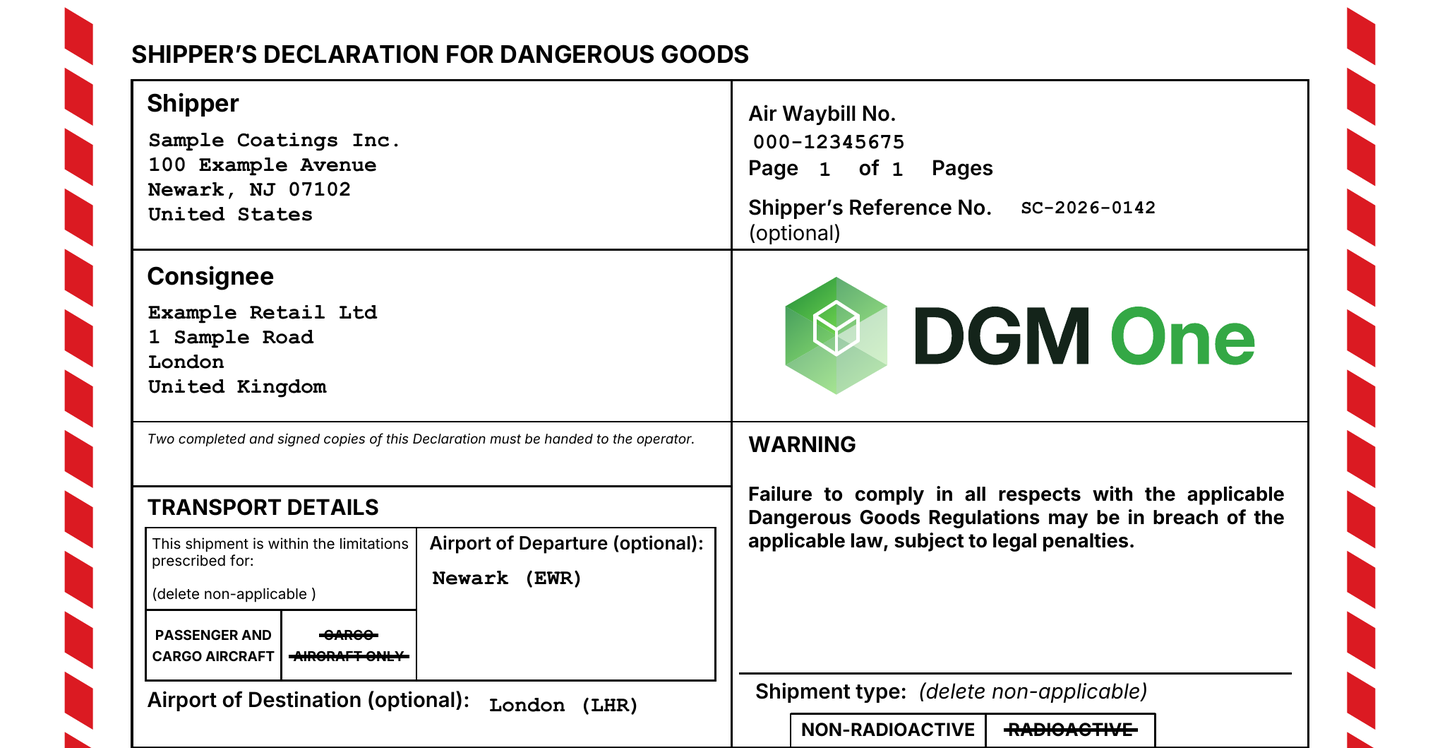
| Field | What goes there | Mistake we see most |
|---|---|---|
| Shipper | The shipper’s full name and address, the party offering the consignment. | The name or address does not match the shipper shown on the air waybill. |
| Air waybill number | The air waybill number the declaration will travel with. | Left blank, or carrying the number of a different air waybill. |
| Page numbering | Page 1 of 1, Page 1 of 2 and so on. | Continuation pages left unnumbered, so nobody can tell if one is missing. |
| Shipper’s reference | An optional internal reference. | A reference that does not tie back to the commercial documents, which slows down every check that follows. |
| Consignee | The full name and address of the party receiving the goods. | The consignee no longer matches the air waybill because someone updated one document and not the other. |
| Aircraft limitations | Passenger and cargo aircraft, or cargo aircraft only, with whichever does not apply struck out. | Both options left standing, or passenger and cargo aircraft left in place even though the package exceeds the passenger aircraft limit or uses a cargo aircraft only packing instruction. |
| Airports of departure and destination | Optional on the IATA form; when used, the airport or city of departure and destination. | Entries that do not match the routing on the air waybill. |
| Shipment type | Non radioactive or radioactive, with whichever does not apply struck out. | Neither option struck out. |
Nature and quantity of dangerous goods
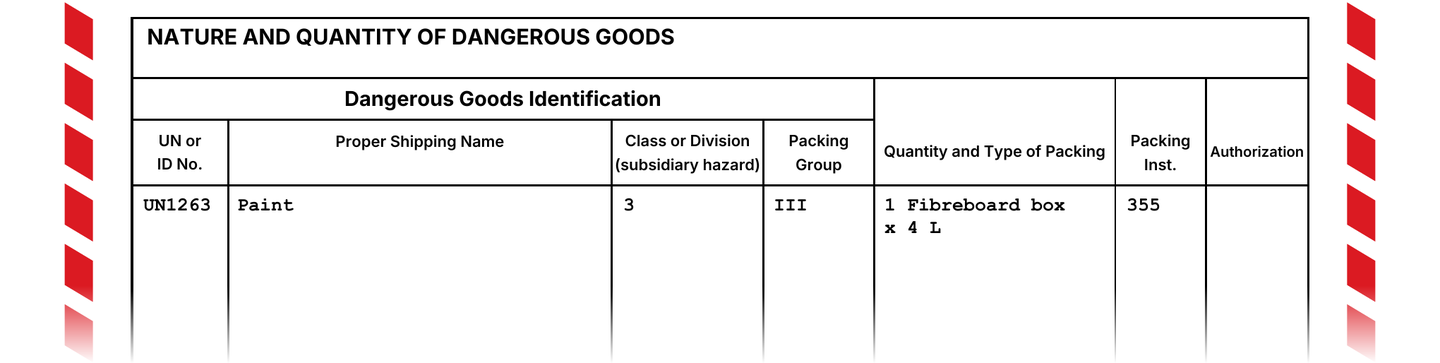
| Field | What goes there | Mistake we see most |
|---|---|---|
| UN or ID number | The identification number from the dangerous goods list, with UN or ID in front of it. | A number pulled from a similar looking entry. Check it against a UN number lookup. |
| Proper shipping name | The proper shipping name exactly as it appears in bold in the list, with only the variations the list allows (singular or plural, for instance), plus the technical name in parentheses where the entry calls for one. | A trade name or product description standing in for the proper shipping name, or a required technical name left out. |
| Class or division | The class or division number, with any subsidiary hazard in parentheses right after it. | The subsidiary hazard left out. |
| Packing group | Packing group I, II or III, where the entry has one. | A packing group copied from the entry next to it, or given for a class that does not use one. |
| Quantity and type of packing | The number and type of packages, and the quantity in each, given as net quantity or gross mass depending on what the entry calls for, with units attached. If it is an overpack, the declaration says so. | Gross mass entered where net quantity was required, units left off, or an overpack that goes undeclared. |
| Packing instruction | The packing instruction actually used, matching the aircraft limitation. Limited quantity instructions carry a Y in front of the number. | A passenger aircraft instruction next to a quantity only allowed on cargo aircraft, or no instruction at all. |
| Authorizations | Special provision numbers where the provision says they must be shown, and references to any approval or exemption. | An approval referenced without a copy traveling with the shipment, where the approval requires one. |
Additional handling information and certification
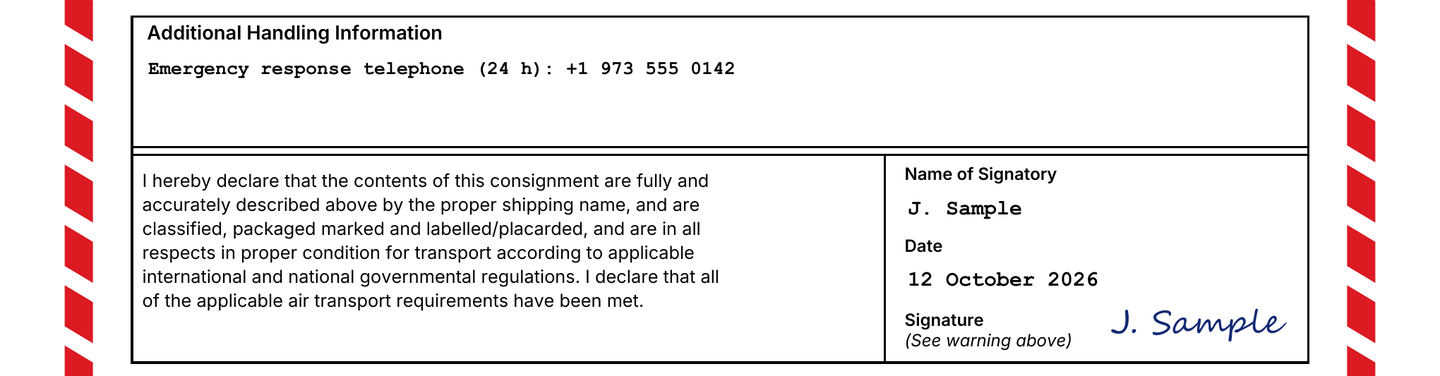
| Field | What goes there | Mistake we see most |
|---|---|---|
| Additional handling information | Statements that a specific entry, a special provision, or a state or operator variation calls for, such as an emergency response telephone number where one is required. | A required statement left out because someone treated the box as optional. |
| Certification | The printed certification statement, unchanged, plus the name of the signatory, the date and the signature. | A signatory whose training has lapsed, a missing name or date, or edits to the form that nobody signed for. |
The order of the basic description
The first four items in the nature and quantity block make up the basic description, and they always come in this order:
- UN or ID number
- Proper shipping name, with the technical name where required
- Class or division, with any subsidiary hazard
- Packing group
The IMO dangerous goods declaration, the 49 CFR shipping paper and the ADR and RID transport document all follow roughly the same order, then build outward from it. Air adds the quantity and type of packing plus the packing instruction. Ocean adds items like marine pollutant status and the minimum flashpoint for goods flashing at 60°C (closed cup) or below. US ground adds the total quantity and the number and type of packages. ADR adds a tunnel restriction code where one applies. Learn this order once, and any mode’s declaration gets easier to read.
Example: a shipper’s declaration of dangerous goods for one box of paint
Here is how a simple consignment reads on the air form: one fibreboard box holding 4 L of paint, UN 1263, Class 3, Packing Group III, shipped under passenger aircraft packing instruction 355. The names, addresses and numbers are samples.
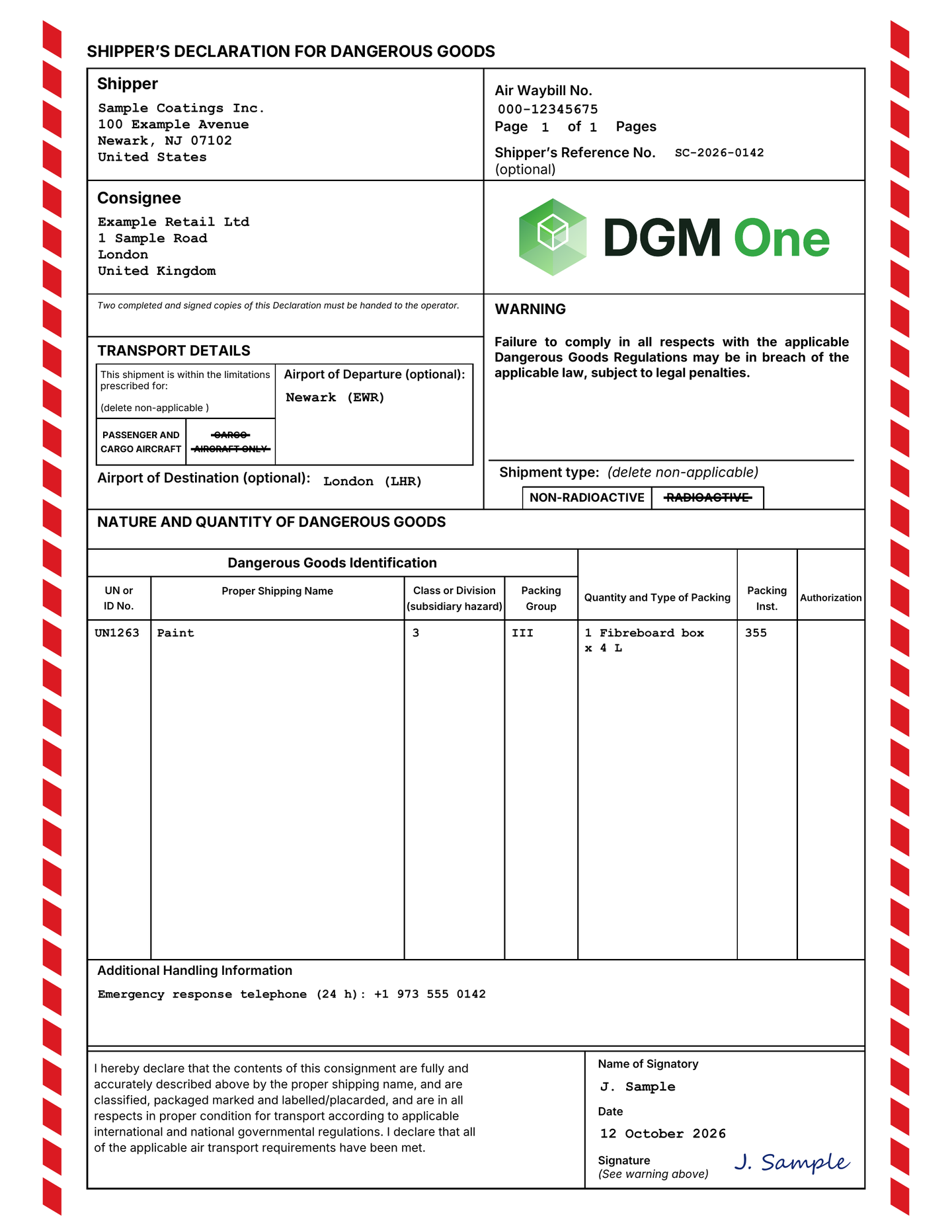
| Field | Example entry |
|---|---|
| Shipper | Sample Coatings Inc., 100 Example Avenue, Newark, NJ 07102, United States |
| Air waybill number | 000-12345675 |
| Page | Page 1 of 1 |
| Shipper’s reference | SC-2026-0142 (optional) |
| Consignee | Example Retail Ltd, 1 Sample Road, London, United Kingdom |
| Aircraft limitations | Passenger and cargo aircraft (cargo aircraft only struck out) |
| Airport of departure | Newark (EWR) (optional) |
| Airport of destination | London (LHR) (optional) |
| Shipment type | Non radioactive (radioactive struck out) |
| UN or ID number | UN1263 |
| Proper shipping name | Paint |
| Class or division | 3 |
| Packing group | III |
| Quantity and type of packing | 1 Fibreboard box x 4 L |
| Packing instruction | 355 |
| Authorizations | None in this example |
| Additional handling information | Emergency response telephone (24 h): +1 973 555 0142 |
| Name of signatory | J. Sample |
| Date | 12 October 2026 |
| Signature | The trained signatory’s signature |
Why these entries look the way they do: 4 L sits well within the passenger aircraft limit for this entry, so passenger and cargo aircraft stays in place and cargo aircraft only gets struck out. This paint entry carries no subsidiary hazard, so the class entry is just 3. Among other requirements, the box itself has to show the same UN number and proper shipping name, the Class 3 hazard label and the shipper and consignee details, and the air waybill has to reference the attached declaration.
Illustrative only. This example shows how the fields fit together, not a form to copy. Your own entries have to come from the current DGR, any variations that apply, and the goods you are actually shipping.
Errors that get a DG declaration rejected
- Proper shipping name does not match the list. Trade names, abbreviations and product codes do not count as proper shipping names.
- Missing technical name on an n.o.s. entry. Not every n.o.s. or generic entry needs one. But where the list flags the entry as requiring it, the technical name of the hazardous constituent, or constituents, goes in parentheses after the proper shipping name.
- Wrong or missing packing instruction. The instruction has to match the entry, the packing group and the aircraft limitation.
- Quantity over the passenger aircraft limit, with passenger and cargo aircraft left in place. Once a package exceeds the passenger aircraft limit, it can only travel on cargo aircraft, within the cargo aircraft limit, and the declaration has to say so.
- Missing subsidiary hazard. When the list entry, or the classification of the goods, assigns a subsidiary hazard, it has to show up on the declaration and, as a rule, on the package label too.
- Net versus gross confusion. Most entries get declared by net quantity, some by gross mass, marked with a G after the figure. Mix the two up and you change whether the package sits within its limit.
- Overpack not declared. Pack packages into an overpack, and the declaration has to say so.
- Alterations not signed. Any change to a completed declaration needs the same signature as the declaration itself.
- Signatory not trained. The person who signs needs current training for the tasks they actually perform. A DGM office near you can provide it for air, IMDG, 49 CFR and ADR.
- Declaration does not match the package or the air waybill. The UN number, proper shipping name, labels and quantities on the box, plus the entries on the air waybill, all have to agree with the declaration.
How DGM One checks the declaration
Look back over the list above and most of these checks turn out to be comparisons: the declaration against the dangerous goods list, against the packing instruction, against the air waybill and the other shipment documents, and against the box itself. That comparison is the work DGM One does. It verifies the declaration against the other documents in the shipment and against the regulations for the mode, while DGeniuschecks it against the package itself: the marks, the labels and the packaging. The declaration stays the shipper’s own document, completed and signed by the shipper’s trained people, and keeping that training current stays the shipper’s job too. Running these checks before the freight is tendered gives you the chance to fix problems before acceptance.
Editorial note: orientation only. This site references IATA DGR 68th edition (the 2027 edition), IMDG Code Amendment 43-26 and ADR 2027, and 49 CFR for US shipments. Until an edition takes effect, the one before it still applies, so always complete and check the declaration against the edition in force for your mode on the date you ship and, for air, any state or operator variations.
Questions shippers ask
What is a shipper's declaration for dangerous goods?
It is the document where the shipper describes the dangerous goods in a consignment and signs to certify they have been correctly identified and classified, and packed, marked and labeled the way the regulations require. For air, that is the Shipper's Declaration for Dangerous Goods set out in section 8 of the IATA Dangerous Goods Regulations. Ocean and US ground shipments carry a comparable signed declaration or certification. European road and rail use a transport document that describes the goods but carries no signed shipper's certification.
Who signs the dangerous goods declaration, and what training do they need?
The shipper signs it. An agent, a freight forwarder for instance, can sign on the shipper's behalf, but some operators restrict or refuse that, so check first. Whoever signs has to be trained for the tasks they are performing. By air, that means training for the shipper functions under the IATA DGR, with recurrent training due within 24 months. Under 49 CFR, hazmat employee training is required and has to be repeated at least every three years. Since the signature certifies that the consignment was prepared correctly, it should come from whoever actually prepared or checked it.
Is the IMO dangerous goods declaration the same as the air shipper's declaration?
No. The IMO dangerous goods declaration follows chapter 5.4 of the IMDG Code and is often made on the multimodal dangerous goods form. It shares the same basic description as the air form (UN number, proper shipping name, class and packing group), but it has no aircraft limitation or packing instruction entries. It adds ocean specific items instead, such as marine pollutant status and, when the goods go into a container or vehicle, a packing certificate. Each mode's document has to satisfy that mode's own rules, so an air declaration does not stand in for the ocean one.
Can a dangerous goods declaration be electronic?
Often, yes. Both the IATA DGR and the IMDG Code allow the declaration information to travel by electronic data transmission instead of on paper, generally once the carrier agrees to it, and the information has to match what would appear on the paper document. Whether a printed copy still has to travel with the freight depends on the mode and the carrier, so confirm the arrangement before you rely on it.
Do limited quantities by air need a shipper's declaration?
Yes. Dangerous goods shipped as limited quantities by air still get declared on a Shipper's Declaration for Dangerous Goods, with the Y prefixed packing instruction shown. Excepted quantities do not need a declaration, and neither do lithium battery shipments prepared under Section II of the relevant packing instruction. A handful of other entries travel without one too, such as UN 3373 and dry ice used only as a refrigerant for goods that are not themselves dangerous, with the required details shown on the air waybill instead.
What happens when the declaration and the package disagree?
If the carrier catches the mismatch at acceptance, the shipment gets held. The carrier checks the declaration against the package marks and labels and against the air waybill, and any mismatch gives them grounds to refuse the shipment until the shipper fixes the package or the declaration. A corrected declaration has to be signed again, and goods found to be misdeclared can be reported to the authorities, which can mean penalties.